
Universal Skid Steer Loader Specification & Capacity Directory
Skid steer operating weights span 2,800 to 11,500 lbs with 700 to 4,200 lbs rated operating capacity (ROC). Hydrostatic drive circuits require high-shear ISO VG 46 anti-wear or heavy-duty 10W-30 hydraulic fluid.
Engine & Powertrain
- Engine Model
- Kubota V1702 4-Cyl Diesel
- Gross Output
- 36 HP
- Crankcase Oil
- 8.5 qts (15W-40 Heavy Duty Diesel (API CK-4))
- Cooling System
- 11.5 qts (50/50 Ethylene Glycol)
Hydraulic Circuit & Flow
- Auxiliary Flow
- 15.5 GPM (Standard Flow)
- Relief Pressure
- 2350 PSI
- Hydraulic HP
- 21.2 HHP (GPM × PSI / 1714)
- Total System Vol
- 10.5 US Gal (Includes cylinders)
Standard fluid and filter service requires exactly 8.0 gallons to reach the center of the sight glass. Overfilling causes foaming and oil expansion leaks through the breather cap.
The lift and tilt cylinders plus oil cooler lines hold approximately 2.5 gallons. Complete dry rebuilds require 10.5 total gallons.
The chain case holds 6.0 gallons. It is completely isolated from the hydraulic loop. Never fill the hydraulic reservoir attempting to lubricate drive chains.
Wix / Donaldson OEM Filter Cross-Reference
Interactive Hydraulic & Drivetrain Chassis Blueprint
Main Hydraulic Reservoir (8.0 – 15.6 US Gallons)
Stores primary fluid for boom cylinders and charge feed to hydrostatic pumps. Must meet ISO VG 46 anti-wear standards with zinc additives (ZDDP) to prevent drive motor slipper foot wear.
Hydrostatic Axial Piston Pumps (3,000 – 4,000 PSI)
Closed-circuit bi-directional pumps delivering continuous high-pressure flow to drive motors. Standard universal tractor fluid (UTF) will shear down under point loads, causing catastrophic cavitation.
Independent Chain Case Sump (6.0 – 10.0 US Gallons)
Completely isolated from the hydraulic loop. Contains drive chains and sprockets submerged in 10W-30 or 10W-40 motor oil. Never fill through the hydraulic tank breather cap.
Auxiliary Hydraulic Quick-Disconnect Manifold
Delivers standard flow (15–24 GPM) or high flow (30–45 GPM) to attachments. High-flow attachments require a dedicated low-pressure case drain line to prevent motor shaft seal blowout.
Diesel Engine Crankcase & Cooling Pack
Liquid-cooled diesel engines (Kubota, Cummins, Cat, Yanmar) holding 8.5 to 14.0 quarts of API CK-4 15W-40 oil with 100-hour severe service change intervals.
Hydrostatic Viscosity & Shear Defense
High-pressure tandem axial piston pumps operate between 2,500 and 4,000 PSI. Maintaining anti-wear ZDDP levels above 1,200 ppm prevents slipper plate wash and valve block scoring under heavy duty cycles.
Kubota V1702 Diesel Architecture
Legendary naturally aspirated 4-cylinder mechanical diesel powering the Bobcat 743. Features spherical combustion chambers, gear-driven camshaft, and 500-hour oil service intervals for job site durability.
Commercial Fleet Engineering & Field Service Dossier
 AI Visual
 Understanding Skid Steer Weight Ratings: ROC vs. Tipping Load
Equipment operators and hauler drivers must distinguish between factory shipping weight, operational ground pressure, and safe bucket capacities to prevent machine rollover accidents and highway trailer violations.
What is the difference between Rated Operating Capacity (ROC) and Tipping Load?
Direct Answer: Rated Operating Capacity (ROC) on wheeled skid steers is legally mandated by SAE J818 standards to never exceed 50% of the machine's static tipping load. On compact track loaders (CTLs), the statutory ROC threshold is restricted to 35% of tipping load due to rubber track pivot geometry.
Wheeled Skid Steers (50% SAE J818 Rule)
On standard 4-wheel drive skid steers (such as the Bobcat 743 or Case 1845C), the tipping load represents the exact downward force on the bucket cutting edge required to lift the rear drive tires off the pavement. Operating at more than 50% of this limit drastically increases forward tipping risks during downhill transport, rapid braking, or boom elevation on uneven terrain.
Compact Track Loaders (35% ISO 14397 Rule)
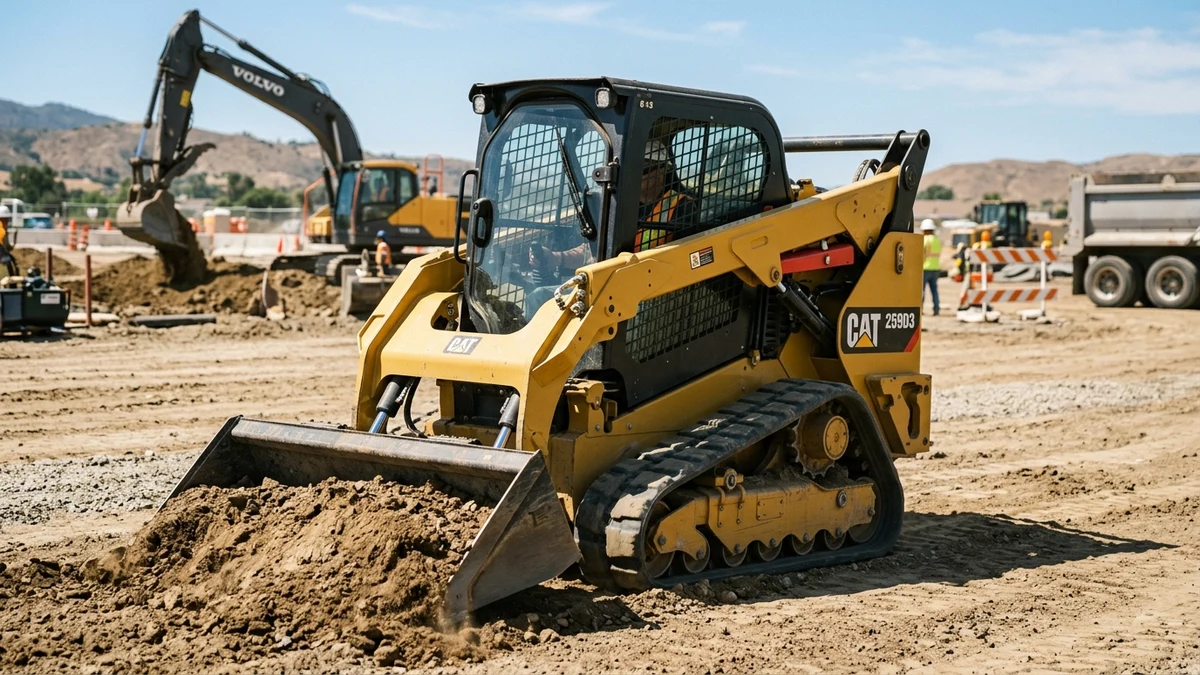
Because tracked machines (such as the Kubota SVL75-2 or Cat 259D3) feature an extended longitudinal ground contact patch, their tipping moment behaves differently. Under ISO 14397-1 and SAE standards, track loaders are rated at strictly 35% of tipping load for safe bucket loading in soft mud, sand, and steep slopes.
How do bolt-on counterweights alter skid steer capacity and trailer balance?
Direct Answer: Adding rear counterweights shifts the machine's center of gravity backward, increasing Rated Operating Capacity by 150 to 400 lbs depending on bracket leverage, but simultaneously increases total trailer towing weight and reduces front tire traction during empty bucket travel.
The front axle or track front idler serves as the physical fulcrum for all bucket leverage moments.
Every 100 lbs of cast iron bolted to the rear bumper increases forward bucket stability by roughly 130 to 180 lbs.
Rear-heavy loaders require repositioning forward on equipment trailers to maintain the essential 10% to 15% hitch tongue weight.
Essential Skid Steer Fluid Specifications: What Goes Where?
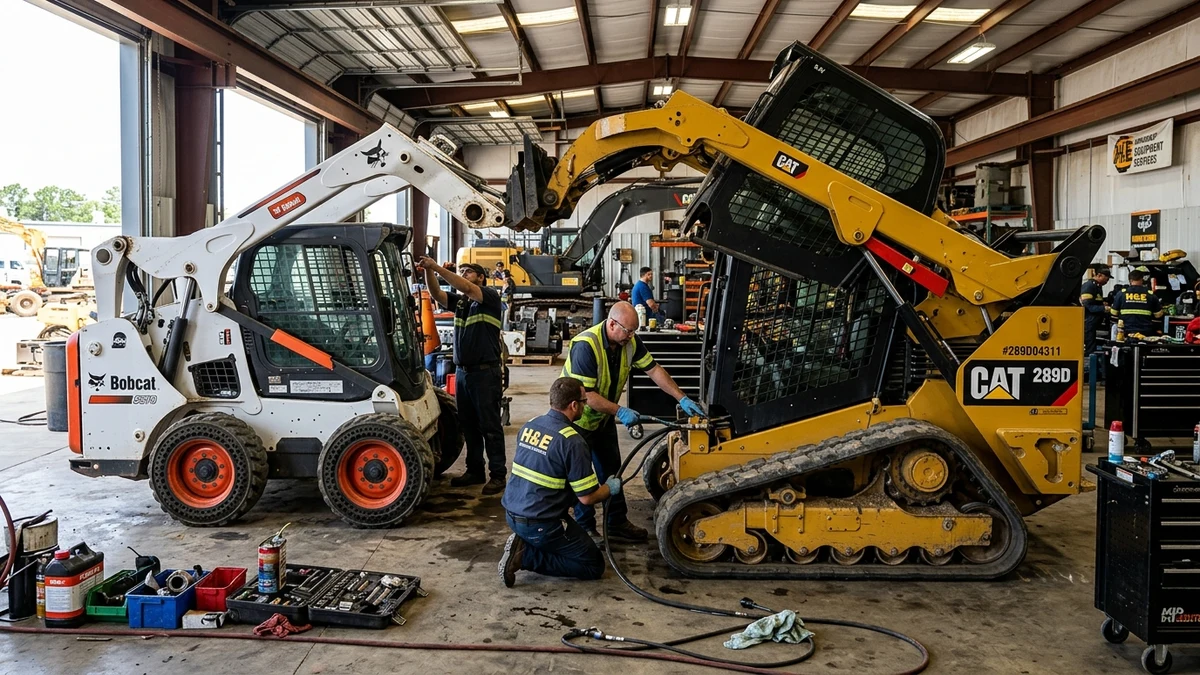
The most catastrophic and expensive mistake on vintage and modern skid steers is cross-contaminating the hydraulic reservoir with the chain drive case.
What is the difference between hydraulic oil and hydrostatic drive fluid?
Direct Answer: On modern compact equipment, the main hydraulic reservoir supplies fluid to both the low-pressure gear pump (loader boom lift and tilt cylinders) and the high-pressure hydrostatic axial piston drive pumps (which operate between 2,500 and 4,000 PSI). Fluid must possess high shear stability (ISO VG 46) and high-zinc anti-wear additives (ZDDP) to prevent drive motor slipper foot breakdown.
When servicing equipment, operators frequently ask whether heavy-duty motor oil or standard tractor hydraulic fluid (UTF) can be poured into the reservoir. As detailed in our exhaustive skid steer hydraulic fluid cross-reference guide, standard tractor fluid lacks the shear stability required for variable-displacement piston pumps. Using generic fluids risks fluid aeration, pump cavitation, and premature valve block failure.
Why does the chain case require a completely separate lubricant?
Direct Answer: The skid steer chain case is a sealed, independent steel bathtub housing heavy roller drive chains and sprockets submerged in an oil bath. It requires 10W-30 or 10W-40 motor oil (or 80W-90 gear lube on select Case models) and must never be filled via the hydraulic tank breather.
| Subsystem | Operating Pressure | Standard Lubricant Spec | Primary Contamination Threat |
|---|---|---|---|
| Hydrostatic Loop | 2,500 – 4,000 PSI | ISO VG 46 / SAE 10W-30 Anti-Wear | Particle cavitation, fluid shear thinning, moisture degradation |
| Hydraulic Loader Circuit | 2,000 – 3,200 PSI | Shared reservoir with hydrostatic loop | Cylinder rod seal wear, ambient job-site dust ingestion |
| Chain Drive Case | Atmospheric (0 PSI) | SAE 10W-30 Motor Oil / 80W-90 Gear Oil | Axle seal leakage, condensation buildup, metallic sprocket wear metal |
For machine-specific maintenance intervals, such as inspecting the Kubota V1702 diesel or drain plug locations, explore our Bobcat 743 complete specs manual or calculate your attachment flow requirements with the auxiliary hydraulic flow calculator.
Empirical Engineering & Statutory Verification Matrix
All tolerances and fluid formulas cross-checked against primary heavy machinery standards.
| Engineering Parameter | Authoritative Source | Authority Body | Factory Tolerance / Rule |
|---|---|---|---|
| Rated Operating Capacity (Wheeled) | SAE J818_200704 Standard Specification ↗ | Strictly 50% of Tipping Load | |
| Rated Operating Capacity (Tracked CTL) | ISO 14397-1:2007 Earth-moving Machinery ↗ | Strictly 35% of Tipping Load | |
| Hydraulic Horsepower Derivation | Fluid Power Designers Handbook ↗ | HHP = (GPM x PSI) / 1714 | |
| Bobcat 743 Operating Tolerances | Operation & Maintenance Manual #6720230 | 4,720 lbs Weight / 8.0 Gal Reservoir | |
| ISO VG 46 Viscosity Limits | ISO 3448:1992 Industrial Lubricants ↗ | 41.4 to 50.6 cSt @ 40°C |
Frequently Asked Technical Questions
Authoritative mechanical and operational answers verified against OEM shop manuals.
What is the difference between operating weight and shipping weight on a skid steer?
Shipping weight represents the dry machine as loaded at the factory without bucket, attachments, counterweights, or fuel. Operating weight is defined by SAE J818 as the machine fully ready for operation, including a standard dirt bucket, full fuel tank, all operating hydraulic fluids and coolants, plus a standard 165 lb (75 kg) operator.
Can I use universal tractor fluid (UTF) in my skid steer hydraulic system?
No. Standard universal tractor fluid (UTF) is engineered for low-pressure gear transmission sumps with wet disc brakes. Modern skid steer hydrostatic drive pumps operate between 2,500 and 4,000 PSI, requiring high-shear anti-wear hydraulic oil meeting ISO VG 46 or heavy-duty 10W-30 motor oil with at least 1,200 ppm zinc (ZDDP) to prevent drive motor piston cavitation.
How do I check the chain case oil on a Bobcat or Case skid steer?
The chain case is checked via a square or allen-head pipe plug located on the front center frame between the foot pedals or on the lower front axle centerline. Park the machine on level ground, lower the lift arms completely, clean around the plug, and remove it. Fluid should be level with the bottom threads of the inspection hole.
Why does my skid steer move slower or make whining noises in cold weather?
High-pitched whining during cold winter starts indicates hydraulic pump cavitation caused by thick, cold fluid starving the charge pump. If operating below 14°F (-10°C), manufacturers recommend switching to synthetic SAE 5W-30 motor oil or synthetic ISO VG 32 hydraulic fluid and allowing a 10-minute warm-up cycle before operating drive levers.
How much can a typical skid steer lift safely?
Safe lifting capacity is defined by the Rated Operating Capacity (ROC), which is 50% of tipping load on wheeled units and 35% on track loaders. Compact units (like the Bobcat 743) lift 1,300 lbs, mid-frame units lift 1,750 to 2,200 lbs, and heavy commercial loaders (such as the Cat 259D3 or Kubota SVL95) lift 2,900 to 4,200 lbs.